
Annual leave is often seen as a routine part of employment, but if it is managed badly, it can become a serious financial and legal risk for employers.
A recent employment tribunal brought this into sharp focus after a property manager was awarded almost £392,000 for untaken holiday that had built up over many years. The tribunal found that he had accrued 827.25 days of annual leave and was entitled to be paid for it when his employment ended. He also succeeded in claims for unfair dismissal.
While this is an extreme case, the lesson for employers is much broader. Annual leave should never be treated as an informal admin issue. If holiday is not monitored properly, if requests are consistently refused, or if there is no clear record of what has been taken and carried over, the cost can build quietly in the background until it becomes a much bigger problem.
Why this matters for employers
In the UK, most workers are entitled to 5.6 weeks of statutory paid annual leave each year, which for someone working five days a week is 28 days.
That entitlement is not something employers can simply overlook because the business is busy. Operational pressure, staff shortages and unclear internal processes do not remove the employer’s responsibility to manage annual leave properly. In fact, where holiday is repeatedly pushed aside, the risk often grows over time.
This is especially important because employers are expected to communicate clearly about holiday and support workers in taking it. ACAS says employers should communicate early and clearly about taking holiday, regularly check that workers are getting their full entitlement, and remind them of their entitlement and how to use it.
In other words, it is not enough to have a holiday policy sitting in a handbook if it is not being applied in practice.
Where businesses go wrong
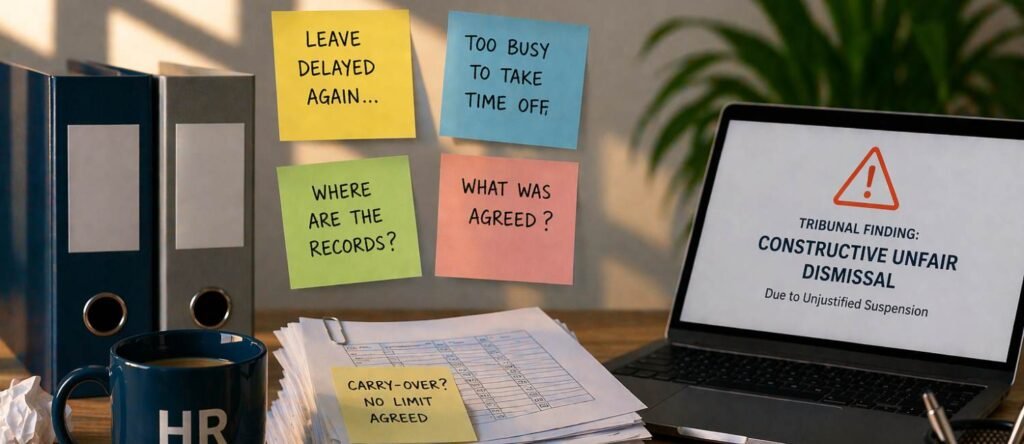
In many organisations, annual leave problems do not start with one major mistake. They usually build through small gaps in process.
For example, managers may delay approving leave because the team is short-staffed. Employees may stop requesting time off after repeated refusals. Holiday records may be incomplete or spread across emails, spreadsheets and verbal agreements. In some cases, businesses allow informal arrangements around carry-over without setting proper limits or documenting what has been agreed.
That is where things become risky.
ACAS explains that workers can carry over some of their statutory holiday where there is a relevant agreement allowing it. That means carry-over is not something employers should deal with casually or assume will sort itself out later.
The danger is not only financial. Poor annual leave management can also create wellbeing issues, resentment, burnout, and disputes about fairness across the workforce. By the time employment ends, what looked like a simple holiday issue can turn into a holiday pay claim, a records problem, and in some cases a wider employment dispute.
Why 2026 is an important time to review this
This issue has become even more relevant because from 6 April 2026, employers must keep records of annual leave and holiday pay. ACAS states that employers must record holiday taken, holiday carried over, holiday pay, and any payments in lieu of holiday, and keep those records for at least six years.
That means businesses should now be able to show, clearly and consistently, how annual leave is being managed.
For employers, this is a good moment to ask some basic but important questions:
- Do we have a clear annual leave process?
- Are managers dealing with leave requests consistently?
- Are employees being actively encouraged to take holiday?
- Do we know who is carrying large balances forward?
- Can we evidence our holiday records if there is a challenge later?
If the answer to any of those is no, there is work to do.
What employers should do now
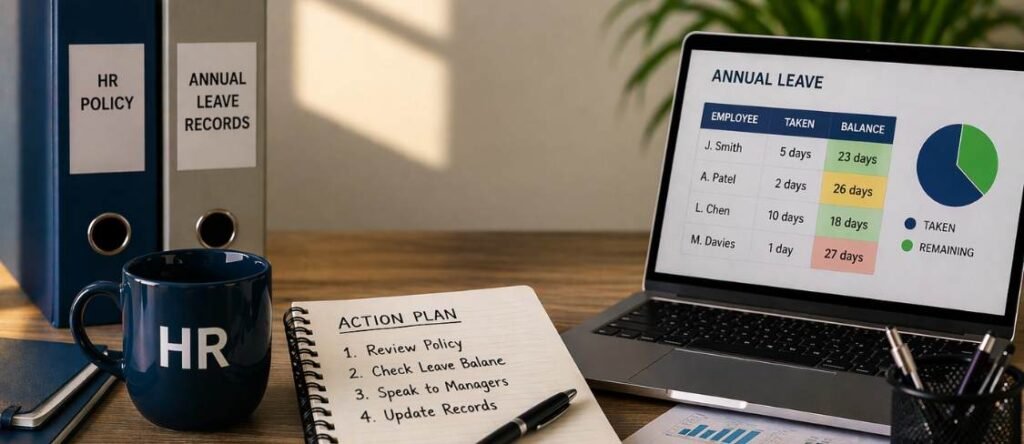
1. Make sure your annual leave policy is clear, up to date and actually followed in practice. Staff should understand how much leave they are entitled to, how to request it, whether carry-over is allowed, and what happens if leave is not used.
2. Monitor leave throughout the year, not just at year end. If someone has taken very little holiday, that should be flagged early. Leaving it too late increases the chance of rushed requests, rejected requests, or a large amount of leave sitting there unresolved.
3. Avoid a culture where people feel they cannot take time off because the business is too busy. That may feel manageable in the short term, but it can create a much bigger problem later.
4. Employers need accurate records. This is now even more important under the new record-keeping requirements. If there is a dispute, poor records make it much harder to show what was agreed, what was taken, and whether the business acted properly.
The real takeaway
This tribunal outcome may sound unusual, but the underlying issue is not. When annual leave is managed informally, ignored because of workload, or allowed to build up without proper oversight, the risk can become far more serious than many employers expect.
Annual leave is not just a scheduling issue. It is a compliance issue, a people issue, and potentially a costly one. That is why employers should review their holiday processes, keep accurate records, and make sure employees are able to take the leave they are entitled to.