
A recent survey has highlighted something many UK employers should pay attention to: there may be a bigger gap than expected between how businesses think employees feel and how employees actually experience work.
According to research reported by People Management, only 60% of UK employees rated their overall employee experience as “good” or “excellent”. This placed the UK second lowest out of seven countries included in the survey, ahead of only Singapore at 56%. In comparison, employee experience was rated more positively in countries including Germany, Sweden, Canada, Mexico and India.
At the same time, the research found a clear disconnect between HR leaders and employees. While 60% of UK employees rated their experience positively, 95% of UK HR leaders rated their organisation’s employee experience as good or excellent, and 84% believed employees would say the same.
For employers, especially SMEs, this raises an important question: are employees experiencing the workplace in the way leaders think they are?
Employee experience is more than benefits
When businesses think about employee experience, benefits are often one of the first areas that come to mind. This is understandable. Benefits, wellbeing initiatives and rewards can all play an important role in how supported employees feel.
However, the survey suggests that benefits alone may not be enough. Two thirds of UK HR leaders said they had expanded employee benefits over the past year, but only 29% of UK employees said their employer had added or expanded benefits. In fact, 11% believed their benefits had been reduced.
This does not necessarily mean employers are doing nothing. It may mean that employees are not clearly seeing, understanding or valuing what has been introduced.
That is where the employee experience gap can begin.
A company may believe it has improved support because it has added benefits, updated policies or introduced wellbeing initiatives. But employees may be judging their experience through something much more immediate: how work feels day to day.
The day-to-day workplace matters

For most employees, workplace experience is shaped by everyday moments.
- It is shaped by how managers communicate.
- How concerns are handled.
- Whether workloads feel manageable.
- Whether people feel recognised.
- Whether policies are clear.
- Whether employees feel comfortable raising an issue.
CIPD describes employee experience as being about creating a work environment where people can have a voice and be at their best, rather than focusing only on isolated initiatives.
This is especially important for small and medium-sized businesses. In many SMEs, people’s issues can feel informal because teams are smaller and communication is often more direct. That can be a strength, but it can also create risk if issues are handled inconsistently.
For example, one manager may deal with a concern through a quick informal chat. Another may document everything. Another may avoid the conversation altogether. Over time, employees may start to feel that decisions are unclear, unfair or dependent on who they speak to.
That kind of inconsistency can affect trust, even when the business has good intentions.
Communication can make or break employee experience
One of the key findings from the survey was that nearly half of UK employees found it difficult to access and understand the full value of their rewards and benefits.
This is a useful reminder for employers. Introducing support is only one part of the process. Employees also need to know what is available, why it matters and how to use it.
CIPD highlights the importance of effective internal communication, including the role of line managers and multi-directional dialogue in helping messages land properly across an organisation.
In practice, this means employers should not rely only on one email, one handbook update or one announcement. If employees are busy, overwhelmed or unsure where to find information, important support can easily be missed.
Good communication should be clear, repeated where needed and easy to understand. It should also give employees space to ask questions and share honest feedback.
Why This Gap Matters
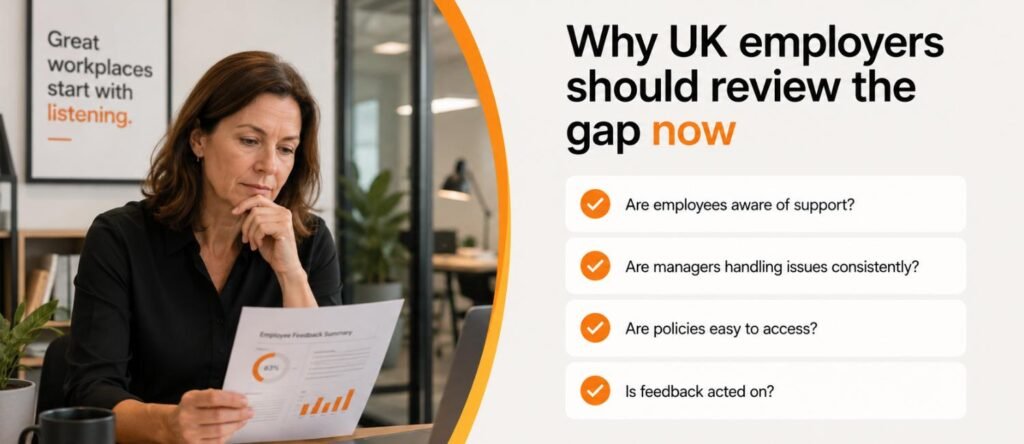
The employee experience gap is not just a “nice to know” HR issue. It can affect engagement, retention, productivity and trust.
If leaders believe employees are happier than they really are, they may miss early warning signs. Employees may appear fine on the surface, while underneath they feel unsupported, unheard or unclear about what help is available.
This is why regular reviews matter. Employers should not assume that having policies, benefits or wellbeing initiatives automatically means employees feel supported.
Instead, businesses should ask:
- Are employees aware of the support available to them?
- Do managers know how to handle people’s issues consistently?
- Are policies easy to access and understand?
- Do employees feel comfortable raising concerns?
- Are informal conversations followed up when needed?
- Is feedback being listened to and acted on?
These questions can help employers move away from assumptions and closer to the real employee experience.
What UK employers can do next
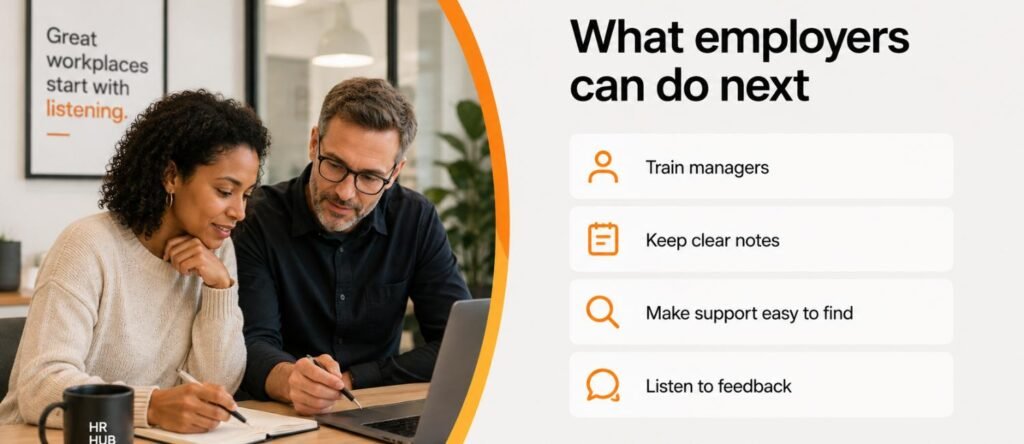
Improving employee experience does not always mean introducing expensive new benefits. In many cases, the starting point is much simpler.
Employers can begin by making sure their existing support is clear, relevant and easy to access. They can also review how managers handle everyday HR situations, from sickness absence and performance concerns to grievances, workload pressures and informal complaints.
Small steps can make a big difference. For example:
- Train managers on how to respond to common people’s issues.
- Keep clear notes when important conversations take place.
- Make policies and benefits easier to find.
- Ask employees what support they actually value.
- Review whether similar situations are being handled consistently.
- Create space for honest feedback, not just annual surveys.
The aim is not to make every workplace conversation formal. It is to make sure the right structure is in place when it matters.
From Assumption to Action
The latest findings show that many UK employers may see employee experience more positively than their employees do. That does not mean businesses are failing. But it does suggest that employers need to look more closely at how work is actually experienced day to day.
Benefits, policies and wellbeing initiatives all have value. But they need to be understood, communicated and supported by consistent people management.
For SMEs, this is where practical HR support can make a real difference. Having someone to turn to when issues come up can help managers respond with more confidence, fairness and clarity.