
A recent employment tribunal ruling involving a construction company has reignited debate about workplace language, race and where the legal line for harassment is drawn.
The case centred on an employee who brought claims of race harassment, direct race discrimination and victimisation after raising concerns about comments made by colleagues. Among them was a remark referring to “two coloured ladies” standing outside the office.
While the tribunal accepted the comment had been made and acknowledged that the term “coloured” is widely regarded as old-fashioned and capable of causing offence, it ultimately dismissed all of the employee’s claims.
So why did the case fail?
Context was key
The tribunal’s decision came down to context rather than the wording alone.
Although many employers would discourage the use of terms such as “coloured” in today’s workplace, the tribunal found the comment had been used as a description of two women rather than as a derogatory remark. There was no evidence that it was intended to humiliate, insult or target the claimant.
A similar conclusion was reached regarding another comment describing a tenant as a “little old Black lady”. Again, the tribunal found the words had been used descriptively rather than with any negative intent.
The judgment serves as a reminder that tribunals do not assess comments in isolation. They consider the wider circumstances, including why something was said and whether it created the type of hostile or degrading environment required under the Equality Act 2010.
Offensive doesn't automatically mean unlawful
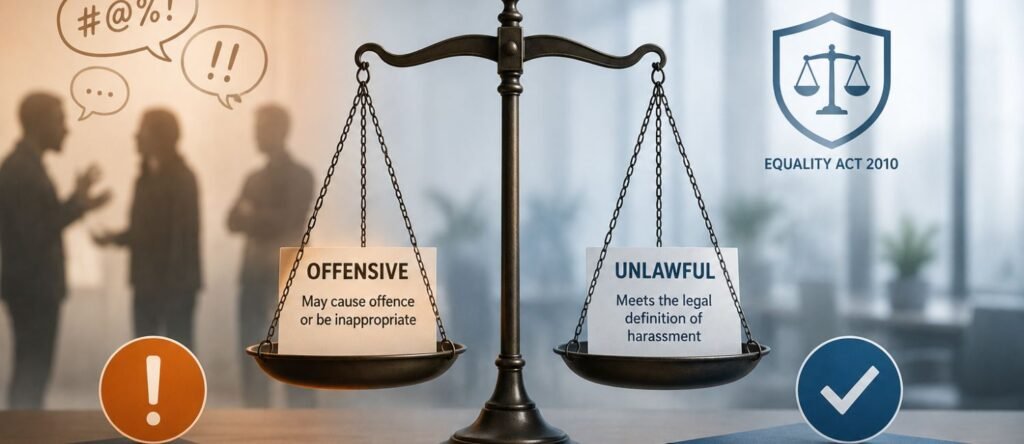
One of the key lessons from the case is that behaviour can be inappropriate without necessarily being unlawful.
To succeed in a harassment claim, an employee must show that unwanted conduct related to a protected characteristic had the purpose or effect of violating their dignity or creating an intimidating, hostile, degrading, humiliating or offensive environment.
The tribunal concluded that threshold had not been met in this case.
In reaching its decision, the judge referred to earlier case law warning against creating “a culture of hypersensitivity” where every unfortunate phrase gives rise to legal liability.
That does not mean employers should ignore concerns about workplace language. Rather, it highlights the distinction between conduct that may cause offence and conduct that meets the legal definition of harassment.
The employer's response mattered
The tribunal also looked closely at how the employer responded once concerns were raised.
Managers discussed the issues with the employee, offered HR support, shared guidance on respectful workplace behaviour and investigated the formal grievance. The tribunal found the employer had engaged positively with the employee and taken reasonable steps to address the concerns.
For HR teams, that is a valuable takeaway. Even where discrimination is ultimately not found, employers should ensure concerns are listened to, investigated and handled consistently.
A reminder for employers

While the employer successfully defended the claim, the case should not be viewed as a green light for outdated workplace language.
Language evolves, and comments that are not unlawful can still damage workplace culture, trust and employee relations. That’s why employers should focus not only on legal compliance but also on creating respectful and inclusive working environments.
Regular Equality, Diversity and Inclusion (EDI) training can help employees and managers understand appropriate workplace behaviour, use inclusive language and respond effectively when concerns are raised.
HR Hub Plus offers online EDI training for employees and managers, helping organisations build more inclusive workplaces while reducing the risk of workplace disputes and tribunal claims.