When employment tribunals make headlines, it’s often because the facts are unusual, the award is substantial, or the lessons for employers are too important to ignore.
A recent case involving the production company behind a Star Wars television series ticks all three boxes.
The tribunal awarded more than £234,000 to a health and safety manager who successfully claimed victimisation after raising concerns that she had been replaced by a “white man”. While her race and sex discrimination claims were ultimately dismissed, the tribunal found that her employer had victimised her for making those complaints and that her dismissal had effectively been predetermined.
For HR professionals, this case serves as a powerful reminder that how an organisation responds to complaints can be just as important as the complaint itself.
The Background
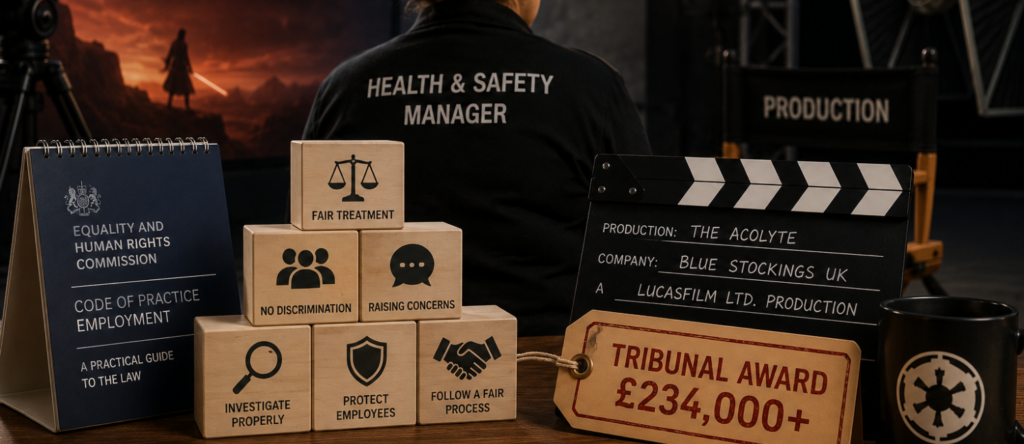
The claimant worked on The Acolyte, a Star Wars spin-off produced by Blue Stockings UK, a Lucasfilm subsidiary.
Following concerns about the structure and performance of the health and safety department, an experienced health and safety adviser was brought into the team. The claimant believed this appointment effectively sidelined her and raised concerns that she had been unfairly replaced by a white male colleague.
The employer later dismissed her for comments made during discussions about the appointment, arguing that her language was inappropriate and discriminatory.
However, the tribunal took a different view.
Although it rejected her claims of direct race and sex discrimination, it found that she had been victimised for raising concerns that she genuinely believed related to discrimination. The judge concluded that managers had effectively used those complaints against her and described the dismissal process as “predetermined”.
The result? A tribunal award exceeding £234,000 and a costly lesson in complaint handling.
A Complaint Doesn't Have to Be Proven to Be Protected
One of the most misunderstood areas of employment law is victimisation.
Many employers assume that if an employee’s discrimination claim is later found to be unfounded, any associated complaint automatically loses protection.
That isn’t how the law works.
Employees are protected when they raise concerns about discrimination in good faith. The tribunal does not require them to ultimately prove discrimination occurred. What matters is whether they genuinely believed they were raising a legitimate concern under equality legislation.
In this case, the tribunal accepted that the claimant’s concerns constituted a protected act, even though her underlying discrimination claims did not succeed.
For HR teams, this distinction is critical.
When Investigations Become About the Individual Instead of the Issue
One of the most striking aspects of the judgment was the tribunal’s criticism of how the complaint was handled.
Rather than focusing solely on investigating the concerns raised, managers became increasingly focused on the employee herself and the way she expressed those concerns.
The tribunal concluded that her complaints were effectively manipulated into grounds for dismissal.
Whether or not employers agree with an employee’s allegations, disciplinary action should never appear to be retaliation for speaking up.
Employees must feel able to raise concerns without fear that doing so will damage their career or employment.
The Danger of a Predetermined Outcome
The judge’s use of the word “predetermined” should make every HR professional sit up and take notice.
Few criticisms carry more weight in tribunal proceedings.
A fair disciplinary process requires decision-makers to remain open-minded until all evidence has been considered. When managers appear to have reached a conclusion before an investigation is complete, the entire process can become vulnerable to challenge.
Common warning signs include:
- Investigations that focus only on evidence supporting dismissal.
- Decision-makers becoming involved too early in the process.
- Failure to properly consider alternative explanations.
- Dismissing mitigating circumstances without discussion.
- Documentation that suggests conclusions were reached before hearings took place.
Even where there are legitimate conduct concerns, procedural fairness remains essential.
Why Manager Training Matters
Cases like this also highlight the growing importance of training managers to handle sensitive workplace conversations.
Discussions involving race, gender, discrimination and equality can be challenging. Emotions may run high, language may not always be perfectly expressed, and differing perspectives can create tension.
However, managers must be equipped to separate:
- A discrimination complaint from misconduct.
- A protected act from inappropriate behaviour.
- A difficult conversation from a disciplinary issue.
Without proper training, organisations risk escalating concerns that could otherwise have been resolved constructively.
Practical Steps for HR Teams
To reduce the risk of victimisation claims, employers should:
1. Treat all discrimination complaints seriously
Even if a claim appears weak, ensure it is investigated fairly and objectively.
2. Keep complaint and disciplinary processes separate
Avoid allowing frustration with a complaint to influence decisions about conduct or performance.
3. Train managers on protected acts
Many managers understand discrimination law but have limited awareness of victimisation risks.
4. Review disciplinary decision-making
Ensure decision-makers can demonstrate genuine independence and objectivity.
5. Create a culture where concerns can be raised safely
Employees should feel confident that speaking up will lead to investigation, not retaliation.